Antenatal
Understanding the Ovulation Process
September 12, 2026
|
61 views
Ovulation is one of the most important events in the menstrual cycle and plays a central role in natural fertility. It is the process in which an ovary releases a mature egg so that it can potentially be fertilized by sperm.
Understanding ovulation can help women understand their menstrual cycle, recognize changes in their bodies, identify the days when pregnancy is most likely, and know when to seek medical advice for irregular or absent ovulation.
Although many people think ovulation always occurs on day 14, this is only a rough example for a 28-day cycle. In reality, ovulation can occur at different times from person to person and from cycle to cycle. It generally occurs about 10 to 16 days before the next menstrual period, rather than always occurring 14 days after the previous period.
1. What Is Ovulation?
Ovulation is the release of a mature egg from an ovary.
A woman normally has two ovaries, one on each side of the uterus. The ovaries contain eggs and produce reproductive hormones, including estrogen and progesterone.
During the menstrual cycle, hormonal signals cause an egg-containing follicle in an ovary to develop. When the egg has matured sufficiently, a rise in luteinizing hormone (LH) triggers its release.
After ovulation, the egg enters the fallopian tube, where it may meet sperm.
If a sperm fertilizes the egg, pregnancy may begin.
If fertilization does not occur, the egg breaks down and the hormonal changes that follow eventually lead to menstruation.
2. Why Is Ovulation Important?
Ovulation is important because it provides the egg needed for natural conception.
For pregnancy to occur naturally:
An egg must mature.
The ovary must release the egg.
The egg must enter a fallopian tube.
Sperm must reach the egg.
Fertilization must occur.
The resulting embryo must travel toward the uterus and implant successfully.
Without ovulation, there is no egg available for sperm to fertilize.
However, having regular periods does not always guarantee that ovulation is occurring normally. If there are concerns about fertility or irregular cycles, a healthcare professional can perform appropriate testing.
3. The Menstrual Cycle and Ovulation
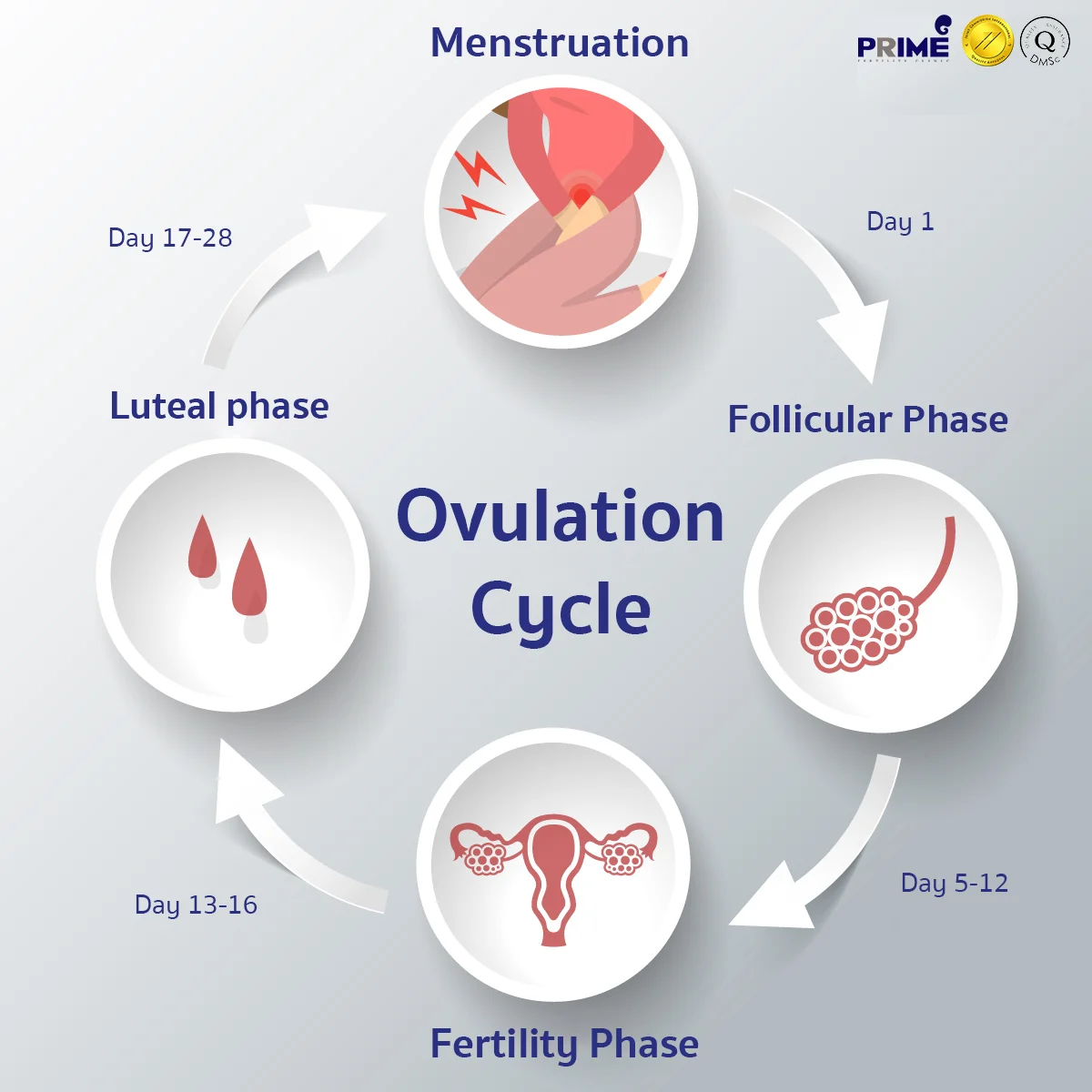
The menstrual cycle is counted from the first day of menstrual bleeding as Day 1.
A cycle can vary considerably between women. Regular cycles of approximately 21 to 35 days can occur in adults.
The menstrual cycle can be broadly divided into four stages:
Menstrual phase
Follicular phase
Ovulation
Luteal phase
These stages are controlled by changes in reproductive hormones.
4. Stage One: Menstrual Phase
The menstrual phase is the period when menstrual bleeding occurs.
If pregnancy did not occur during the previous cycle, estrogen and progesterone levels fall. The lining of the uterus then breaks down and leaves the body through the vagina as menstrual blood.
The first day of bleeding is considered Day 1 of the menstrual cycle.
Menstrual bleeding commonly lasts around 2 to 7 days, although individual experiences vary.
Common menstrual symptoms
Some women experience:
Abdominal cramps
Lower back pain
Breast tenderness
Headaches
Fatigue
Mood changes
Bloating
Not every woman experiences these symptoms.
5. Stage Two: Follicular Phase
The follicular phase begins on the first day of menstruation and continues until ovulation.
During this stage, the pituitary gland produces follicle-stimulating hormone (FSH).
FSH encourages follicles in the ovaries to develop.
A follicle is a small fluid-filled structure containing an immature egg.
Usually, one dominant follicle becomes the main follicle that develops toward ovulation.
As the follicle develops, it produces increasing amounts of estrogen.
Rising estrogen helps the uterine lining begin to thicken again in preparation for a possible pregnancy.
FSH plays an important role in the development and maturation of eggs.
6. Stage Three: Ovulation
Ovulation occurs when the mature egg is released from the ovary.
A key event leading to ovulation is a rapid increase, or surge, in luteinizing hormone (LH).
LH helps trigger the release of the mature egg from the ovary.
The egg then enters the fallopian tube.
This is the period when conception is most likely if sperm is present.
7. What Happens to the Egg After Ovulation?
After the egg is released, it is guided into the fallopian tube.
The egg can then encounter sperm.
If fertilization occurs, the fertilized egg begins developing and eventually travels toward the uterus.
If fertilization does not occur, the egg survives for only a short period.
A released egg is generally capable of being fertilized for less than 24 hours.
This is why the days before ovulation are also important for conception.
8. Stage Four: Luteal Phase
After the egg is released, the follicle that contained it changes into a structure called the corpus luteum.
The corpus luteum produces progesterone.
Progesterone helps prepare and maintain the uterine lining for possible implantation.
If pregnancy does not occur, hormone levels eventually fall.
The uterine lining then breaks down, resulting in the next menstrual period.
The cycle starts again.
9. The Main Hormones Involved in Ovulation
Ovulation is controlled by a coordinated interaction between several hormones.
Follicle-Stimulating Hormone (FSH)
FSH helps stimulate the development of ovarian follicles and prepares an egg for ovulation.
Estrogen
Estrogen rises as the dominant follicle develops.
It contributes to the growth of the uterine lining and helps create the hormonal conditions that lead to the LH surge.
Luteinizing Hormone (LH)
LH rises sharply shortly before ovulation.
This LH surge triggers the release of the mature egg.
Progesterone
Progesterone rises after ovulation.
It helps prepare the uterus for possible implantation.
10. When Does Ovulation Occur?
One of the most common misconceptions is that ovulation always happens on Day 14.
This is not true for everyone.
For example, someone with a 28-day cycle may ovulate around the middle of the cycle, but someone with a shorter or longer cycle may ovulate at a different time.
A more useful general rule is:
Ovulation often occurs about 10 to 16 days before the next period begins.
Because cycle length can change, predicting ovulation solely by counting days is not always accurate.
11. Example of Ovulation in a 28-Day Cycle
A simplified example might look like this:
Approximate Day What May Happen
Day 1 Menstrual bleeding begins
Days 1–5 Menstrual phase
Days 6–13 Follicle develops
Around Day 14 Ovulation may occur
Days 15–28 Luteal phase
Around Day 28 Next period may begin if pregnancy does not occur
This is only an example.
A woman with a 28-day cycle does not necessarily ovulate exactly on Day 14.
12. What Is the Fertile Window?
The fertile window is the period during which sexual intercourse is most likely to result in pregnancy.
It includes the days leading up to ovulation and a short period around ovulation.
Why?
Because sperm can survive inside the female reproductive tract for several days, while the egg remains available for fertilization for a much shorter time.
MedlinePlus notes that sperm can survive for several days, while a released egg generally survives for less than 24 hours.
Therefore, intercourse before ovulation can result in pregnancy.
This is an important point: waiting until the exact day of ovulation is not necessary when trying to conceive.
13. Signs of Ovulation
Some women notice physical changes around ovulation.
Possible signs include:
Changes in cervical mucus.
Mild pelvic or lower abdominal discomfort.
Increased sexual desire.
Breast tenderness.
Mild bloating.
A slight increase in basal body temperature after ovulation.
Changes in mood or energy.
Not every woman experiences noticeable symptoms.
14. Cervical Mucus During Ovulation
One of the most useful natural signs of approaching ovulation is a change in cervical mucus.
As ovulation approaches, cervical mucus may become:
Clear.
Wet.
Slippery.
Stretchy.
It is often compared with the appearance and consistency of raw egg white.
This type of mucus can help sperm move through the reproductive tract.
After ovulation, the mucus often becomes thicker and less slippery.
15. Ovulation Pain
Some women experience mild pelvic pain around the time of ovulation.
This is sometimes called mittelschmerz, meaning "middle pain."
It may occur on one side of the lower abdomen and can last from a short period to longer.
Possible explanations include changes occurring in the ovary as the follicle develops and releases the egg.
Mild, short-lived discomfort may not be concerning.
However, severe, persistent, or unusual pelvic pain should not automatically be assumed to be ovulation pain and should be evaluated by a healthcare professional.
16. Basal Body Temperature and Ovulation
Basal body temperature (BBT) is the body's resting temperature, usually measured immediately after waking and before getting out of bed.
After ovulation, progesterone causes a small increase in basal body temperature.
Tracking this change over several cycles can help a woman identify a pattern and confirm that ovulation probably occurred.
However, BBT generally tells you that ovulation has already happened, rather than predicting it in advance.
MedlinePlus notes that body temperature rises after ovulation and remains higher during the latter part of the cycle.
17. Ovulation Predictor Kits
Ovulation predictor kits are home tests that detect an increase in LH in urine.
An LH surge usually occurs shortly before ovulation.
A positive test therefore suggests that ovulation is likely to occur soon.
According to MedlinePlus, a positive ovulation test generally indicates that ovulation may occur within approximately 24 to 36 hours, although this does not happen identically in every woman.
These tests can be particularly helpful for women who are trying to identify their fertile period.
18. How to Use an Ovulation Test
Instructions vary between brands, so the manufacturer's instructions should be followed.
In general:
Determine your approximate cycle length.
Estimate when ovulation may occur.
Begin testing several days before the expected ovulation.
Test consistently according to the instructions.
Look for the LH surge.
If trying to conceive, have intercourse during the fertile period.
For irregular cycles, determining when to begin testing can be more difficult.
19. Ovulation and Pregnancy
Pregnancy can occur when sperm fertilizes an egg.
The timing of intercourse matters because the egg is available for a relatively short period after ovulation, while sperm can survive for several days.
For couples trying to conceive, regular intercourse throughout the fertile period is generally more practical than trying to identify one exact hour or day.
The NHS advises couples trying to conceive to have sex every 2 to 3 days, with pregnancy being more likely around ovulation.
20. Ovulation and the Menstrual Period
Ovulation and menstruation are connected parts of the menstrual cycle.
A simplified sequence is:
Menstruation → Follicle development → Ovulation → Luteal phase → Menstruation
If pregnancy does not occur, hormone levels fall, and menstruation begins again.
If pregnancy occurs, hormonal changes support the uterine lining, and menstruation does not occur as part of a normal pregnancy.
21. What Happens If Ovulation Does Not Occur?
A cycle in which ovulation does not happen is called an anovulatory cycle.
Occasional irregular cycles can happen.
However, repeated lack of ovulation can make pregnancy difficult because there is no egg available for fertilization.
Possible causes include:
Polycystic ovary syndrome (PCOS).
Thyroid disorders.
Very low or high body weight.
Excessive physical exercise.
Significant stress.
Certain medications.
Primary ovarian insufficiency.
Hormonal disorders.
PCOS can interfere with regular ovulation and is a common cause of ovulatory problems.
22. Irregular Ovulation
Irregular ovulation may occur when:
Periods are very irregular.
Periods are unusually far apart.
Periods stop for several months.
Menstrual cycles change significantly.
Symptoms suggest a hormonal imbalance.
Irregular periods do not always mean infertility, but they can make predicting ovulation more difficult.
If cycles are persistently irregular, medical evaluation can help identify the cause.
23. Factors That Can Affect Ovulation
Ovulation can be affected by many physical and hormonal factors.
Stress
Significant or prolonged stress can affect hormonal signaling.
Weight changes
Being significantly underweight or overweight can affect reproductive hormones and ovulation.
Excessive exercise
Very intense physical activity combined with inadequate energy intake can interfere with normal menstrual function.
PCOS
PCOS can cause irregular or absent ovulation.
Thyroid disorders
Thyroid hormone abnormalities can affect menstrual cycles and fertility.
Age
Fertility generally declines with age, particularly because the number and quality of eggs decrease over time.
Certain medications
Some medications can affect reproductive hormones or ovulation.
24. Ovulation After Stopping Birth Control
Some hormonal contraceptives prevent ovulation while they are being used.
After stopping contraception, the timing of the return of ovulation varies depending on the method and the individual.
For example, some methods allow fertility to return relatively quickly, while the return of regular ovulation can take longer after certain contraceptive methods.
If pregnancy is not desired, contraception should continue until it is appropriate to stop.
25. Can You Ovulate More Than Once?
Occasionally, more than one egg can be released during the same ovulatory period.
If more than one egg is fertilized, this can result in fraternal twins or other multiple pregnancies.
However, releasing two eggs does not mean that a woman routinely ovulates twice at widely separated times during the same menstrual cycle.
26. Ovulation and Twins
There are two main types of twins:
Identical twins
One fertilized egg divides into two embryos.
Fraternal twins
Two separate eggs are fertilized by two separate sperm cells.
Fraternal twins can therefore occur when more than one egg is released during the same cycle.
27. Ovulation and Fertility Awareness
Fertility awareness involves observing menstrual-cycle signs to understand when fertility is higher or lower.
Methods may involve tracking:
Menstrual dates.
Cervical mucus.
Basal body temperature.
Other cycle changes.
These methods can be used for conception planning or, when properly learned and followed, as part of fertility-awareness-based contraception.
However, simply counting calendar days is not always reliable, particularly when cycles are irregular.
28. Ovulation and Sexual Health
Ovulation tracking can help with pregnancy planning, but it does not protect against sexually transmitted infections (STIs).
If STI protection is needed, condoms and appropriate sexual-health measures should be used.
Ovulation tracking should also not be considered a guarantee that pregnancy will or will not occur on a particular day.
29. When Should a Woman Seek Medical Advice?
A healthcare professional should be consulted if there are concerns such as:
Periods stopping unexpectedly.
Very irregular periods.
Cycles consistently outside the usual range.
Severe pelvic pain.
Very heavy or unusual bleeding.
Difficulty becoming pregnant.
Repeatedly negative ovulation tests despite very irregular cycles.
Symptoms suggesting PCOS or thyroid problems.
Signs of premature ovarian insufficiency.
Medical evaluation may include:
Medical and menstrual history.
Physical examination.
Blood hormone tests.
Ovulation testing.
Ultrasound.
Other fertility investigations when appropriate.
30. Ovulation and Infertility
Problems with ovulation are one possible cause of infertility.
However, infertility can involve either partner, both partners, or sometimes no clear cause is identified.
MedlinePlus notes that fertility evaluation can include assessment of ovulation, hormones, reproductive organs, and sperm, depending on the circumstances.
If a woman is under 35 and has been having regular unprotected intercourse for 12 months without becoming pregnant, evaluation is generally recommended.
For women aged 35 or older, evaluation is generally recommended after 6 months of trying.
Earlier evaluation may be appropriate when there are known fertility concerns, such as very irregular or absent periods.
31. Tips for Understanding Your Ovulation
Tip 1: Track your periods
Record the first day of each menstrual period.
Over several months, this can help you understand your cycle pattern.
Tip 2: Observe cervical mucus
Clear, slippery, stretchy mucus can indicate that ovulation is approaching.
Tip 3: Consider an ovulation predictor kit
LH tests can help identify the hormonal surge that precedes ovulation.
Tip 4: Track basal body temperature
A sustained temperature increase can help confirm that ovulation has occurred.
Tip 5: Don't depend entirely on one sign
Using several signs together can provide a clearer picture than relying on a single symptom.
Tip 6: Understand your own cycle
Do not assume that someone else's Day 14 is your Day 14.
Tip 7: Have regular intercourse if trying to conceive
You do not need to identify one exact moment of ovulation. Regular intercourse every 2 to 3 days provides good coverage of the fertile period for many couples.
Tip 8: Maintain healthy habits
Aim for:
Balanced nutrition.
Regular physical activity.
Adequate sleep.
Healthy weight.
Avoidance of tobacco.
Limited alcohol.
Management of excessive stress.
Tip 9: Don't panic about occasional irregularity
One unusual cycle does not necessarily indicate a fertility problem.
Tip 10: Seek help when needed
Persistent irregular periods or difficulty conceiving deserves professional evaluation.
32. Quick Summary of the Ovulation Process
Stage Main Event
Menstruation Uterine lining is shed
Follicular phase Ovarian follicle develops
Estrogen rises Uterine lining begins to thicken
LH surge Triggers egg release
Ovulation Mature egg leaves the ovary
Fertile window Pregnancy is most likely around ovulation
Luteal phase Progesterone rises and prepares the uterus
No pregnancy Hormone levels fall
Next period New menstrual cycle begins
Frequently Asked Questions (FAQs)
1. What exactly is ovulation?
Ovulation is the release of a mature egg from an ovary.
2. Does ovulation happen on Day 14?
Not necessarily.
Day 14 is only an example for a typical 28-day cycle. Ovulation usually occurs about 10 to 16 days before the next period, and the exact timing varies.
3. How long does ovulation last?
The actual release of the egg is a relatively brief event. The egg then remains capable of fertilization for less than about 24 hours. The fertile window, however, spans several days because sperm can survive for several days inside the reproductive tract.
4. Can I get pregnant before ovulation?
Yes.
In fact, intercourse in the days before ovulation can be particularly important because sperm may survive until the egg is released.
5. Can I get pregnant immediately after ovulation?
Pregnancy is possible shortly after ovulation if the egg is still viable, but the probability decreases rapidly once the egg is no longer capable of being fertilized.
6. What is the most fertile time of the cycle?
The highest fertility is generally around the days leading up to ovulation and the time of ovulation itself.
7. How do I know that I am ovulating?
Possible signs include:
Clear, slippery cervical mucus.
Positive LH test.
Mild pelvic discomfort.
Increased sexual desire.
A small rise in basal body temperature after ovulation.
No single sign is perfect for everyone.
8. Can you ovulate without having a period?
Ovulation and menstruation are closely connected, but unusual bleeding patterns can occur. It is possible for bleeding to occur without normal ovulation, and the timing of ovulation can be difficult to predict when periods are irregular.
If periods are absent or very irregular, speak with a healthcare professional.
9. Can you have a period without ovulating?
Yes.
Anovulatory cycles can occur, particularly with hormonal disturbances or certain reproductive conditions.
10. Can stress stop ovulation?
Significant stress can interfere with the hormonal processes that regulate ovulation in some women.
Persistent cycle changes should be discussed with a healthcare professional.
11. Does every woman feel ovulation pain?
No.
Some women experience mild pelvic pain around ovulation, while many do not feel anything noticeable.
12. Is clear stretchy discharge normal?
Yes.
Clear, slippery, stretchy cervical mucus is commonly associated with the fertile period and approaching ovulation.
However, discharge accompanied by strong odor, itching, burning, pain, or unusual color may indicate an infection or another condition and should be evaluated.
13. Can an ovulation test tell me exactly when the egg is released?
No.
An LH test detects the hormone surge that generally occurs before ovulation. A positive result indicates that ovulation may occur soon, but it does not prove the exact moment that the egg is released.
14. Can I use an ovulation test to prevent pregnancy?
Ovulation tests alone should not be assumed to be a reliable contraceptive method.
If pregnancy prevention is important, use an appropriate contraceptive method.
15. Does having regular periods mean I am definitely ovulating?
Not always.
Regular bleeding often occurs alongside regular ovulatory cycles, but bleeding can sometimes occur without ovulation.
If fertility is a concern, a healthcare professional can assess whether ovulation is occurring.
16. What conditions can interfere with ovulation?
Examples include:
PCOS.
Thyroid disorders.
Significant weight changes.
Excessive exercise.
Certain hormonal disorders.
Primary ovarian insufficiency.
Some medications.
17. When should I see a doctor about ovulation?
Seek medical advice if your periods are consistently very irregular or absent, you have significant pelvic pain, or you are having difficulty becoming pregnant.
For people trying to conceive, fertility evaluation is generally considered after 12 months of regular unprotected intercourse if under 35, or after 6 months if 35 or older, with earlier assessment appropriate in some situations.
18. What is the most important thing to remember about ovulation?
The most important point is that ovulation is not necessarily on the same day every month.
Understanding your individual cycle, observing fertility signs, and seeking medical advice when necessary can help you better understand your reproductive health.
Final Summary
Ovulation is a natural and carefully coordinated process controlled by reproductive hormones.
During each cycle, an ovarian follicle develops, estrogen levels rise, and an LH surge triggers the release of a mature egg. The egg then enters the fallopian tube, where it may be fertilized by sperm.
The timing of ovulation varies between women and between cycles. It generally occurs around 10 to 16 days before the next menstrual period, rather than always occurring on Day 14.
For women trying to become pregnant, understanding cervical mucus, using ovulation predictor kits, tracking menstrual cycles, and recognizing the fertile window can be helpful.
For women who are not trying to become pregnant, it is important to remember that fertility-awareness signs are not the same as reliable contraception unless a validated fertility-awareness method is being correctly followed.
Most importantly, changes in menstrual cycles, persistent absence of periods, severe pelvic pain, or difficulty conceiving should not be ignored. A healthcare professional can help determine whether ovulation is occurring normally and identify possible underlying causes.