IVF
Indications for Caesarean Section (C-Section)
April 03, 2026
|
133 views
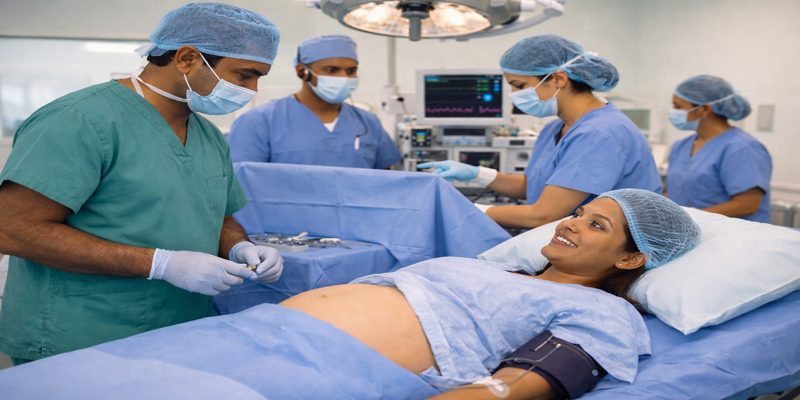
Below is a clear, detailed guide to when and why a C-section may be recommended.
1. Absolute indications (C-section is necessary). These are situations where vaginal delivery would be dangerous or impossible.
Placenta previa:- The placenta covers the cervix either partially or completely.
If labour begins, heavy bleeding can occur and threaten both lives. Vaginal delivery is unsafe.
Obstructed labour / Cephalopelvic disproportion (CPD):-This happens when the baby’s head or body is too large to pass through the mother’s pelvis.
Common causes:
Large baby (macrosomia)
Small or abnormal pelvis
Baby positioned badly
Labour may start but fails to progress.
Uterine rupture or high risk of rupture
If the uterus tears, it becomes a life-threatening emergency.
Risk is high in:
Previous classical C-section scar
Previous uterine surgery (fibroid removal)
Weak uterine wall
Transverse lie
Baby lies sideways across the womb instead of head-down.
Vaginal delivery is impossible.
Severe fetal distress
If the baby is not getting enough oxygen, delivery must happen quickly.
Signs include:
Abnormal heart rate
Reduced fetal movement
Meconium-stained fluid
A C-section can save the baby’s life.
2. Maternal indications
These relate to the mother’s health.
Severe pre-eclampsia/eclampsia
High blood pressure in pregnancy can damage organs and threaten life.
Symptoms:
Severe headache
Vision problems
Swelling
Seizures (eclampsia): Urgent delivery may be the safest option.
Previous multiple C-sections: After two or more C-sections, the uterus may not tolerate labour safely.
Active genital infections
Examples:
Untreated HIV with high viral load
Active genital herpes
C-section reduces the risk of infecting the baby.
Maternal medical conditions
Certain illnesses make labour too stressful for the mother:
Severe heart disease
Certain lung diseases
Some neurological conditions
3. Fetal indications
These focus on the baby’s safety.
Breech presentation
Baby is feet or buttocks first instead of head first.
Types:
Frank breech
Complete breech
Footling breech (most dangerous)
Many breech babies are delivered safely by C-section.
Multiple pregnancy complications
Twins or triplets may require a C-section if:
The first twin is not head-down
Babies share a placenta
Cord complications exist
Cord prolapse
The umbilical cord slips out before the baby.
This cuts off the oxygen supply and requires emergency surgery.
Very large baby (macrosomia)
Common in diabetic mothers. Vaginal delivery may cause injury to the baby or the mother.
4. Labour-related indications
Sometimes labour begins normally, but complications develop.
Failure to progress
Labour stalls despite strong contractions.
Examples: The cervix stops dilating
Baby fails to descend
Prolonged labour (>18 hours)
Failed induction of labour: When medications or methods used to start labour do not work.
Failed assisted delivery: If vacuum or forceps cannot safely deliver the baby.
5. Elective (planned) C-section.n Some are planned before labour begins. Reasons may include:
Previous traumatic vaginal birth
Maternal request after counseling
Known medical risks
Scheduled delivery for safety
Tips for Expectant Mothers
Before delivery
Attend regular antenatal visits.
Ask your doctor about your personal risk factors.
Learn the signs of labour complications early.
Maintain a healthy weight and nutrition.
Control diabetes or blood pressure if present.
If a C-section is planned
Pack early (recovery takes longer than vaginal birth).
Arrange help at home for at least 2 weeks.
Prepare for limited movement after surgery.
Discuss pain control options beforehand.
After a C-section
Start gentle walking early to prevent blood clots.
Keep the incision clean and dry.
Avoid heavy lifting for 6 weeks.
Watch for infection signs:
Fever
Redness
Pus
Severe pain
FAQs
Is a C-section safer than vaginal delivery?
Not automatically. Vaginal birth is usually safer for low-risk pregnancies. C-section is safer when complications exist.
Can I have a normal delivery after a C-section?
Yes. This is called VBAC (Vaginal Birth After Caesarean). Many women qualify, depending on scar type and health.
How long does recovery take?
Basic recovery: 6 weeks
Full internal healing: up to 3 months
Will I feel pain during surgery?
No. Spinal or epidural anesthesia keeps you awake but pain-free. You may feel pressure or pulling.
How many C-sections can a woman have?
Many women safely have 2–3. Risks increase with each surgery due to scar tissue.
Does C-section affect future pregnancies?
It can increase the risk of:
Placenta previa
Placenta accreta
Uterine rupture
Doctors monitor future pregnancies closely.
Is C-section common?
Yes. It is one of the most common surgeries worldwide.
Final note
A C-section is not a failure. It is a life-saving medical procedure. The safest delivery is always the one that protects both mother and baby.